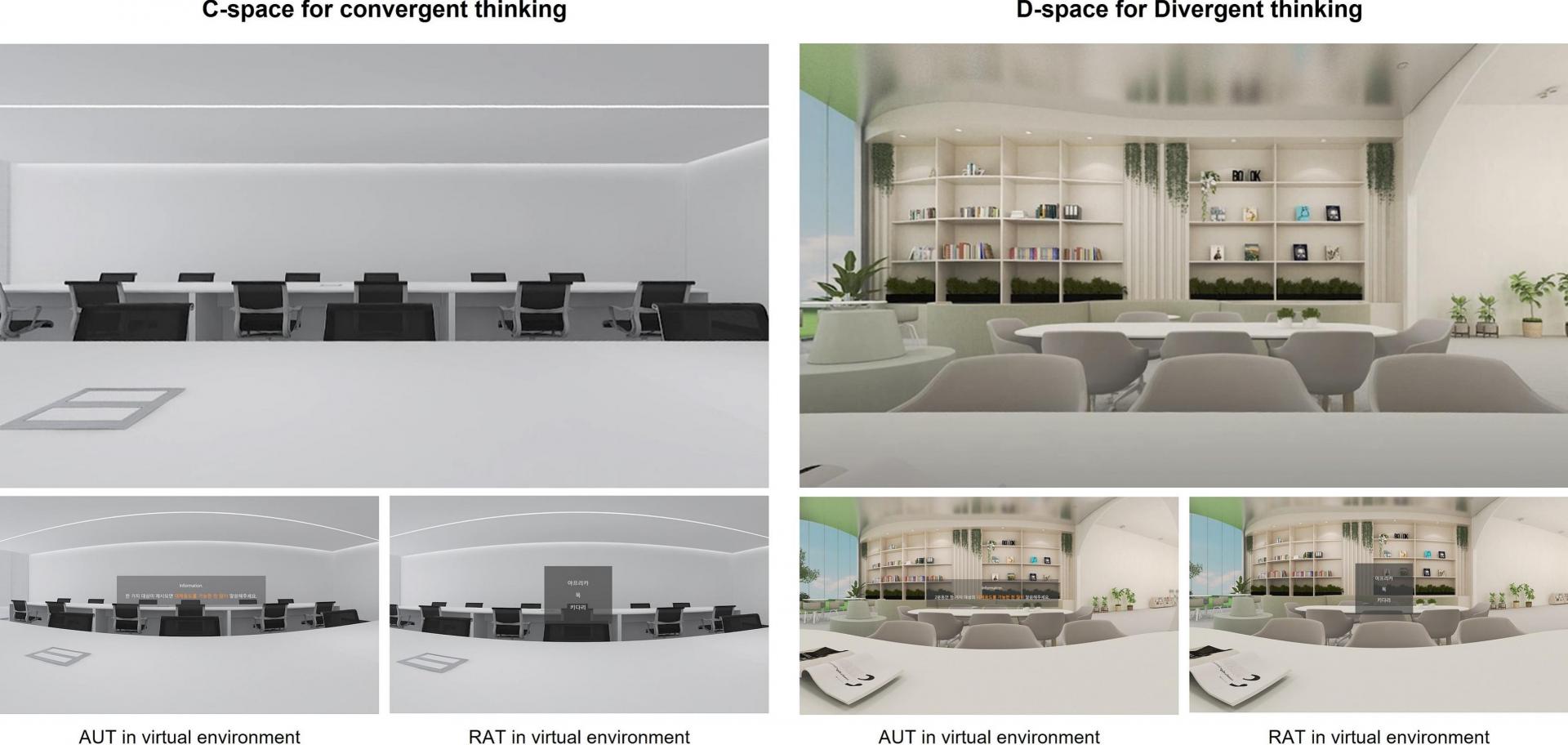
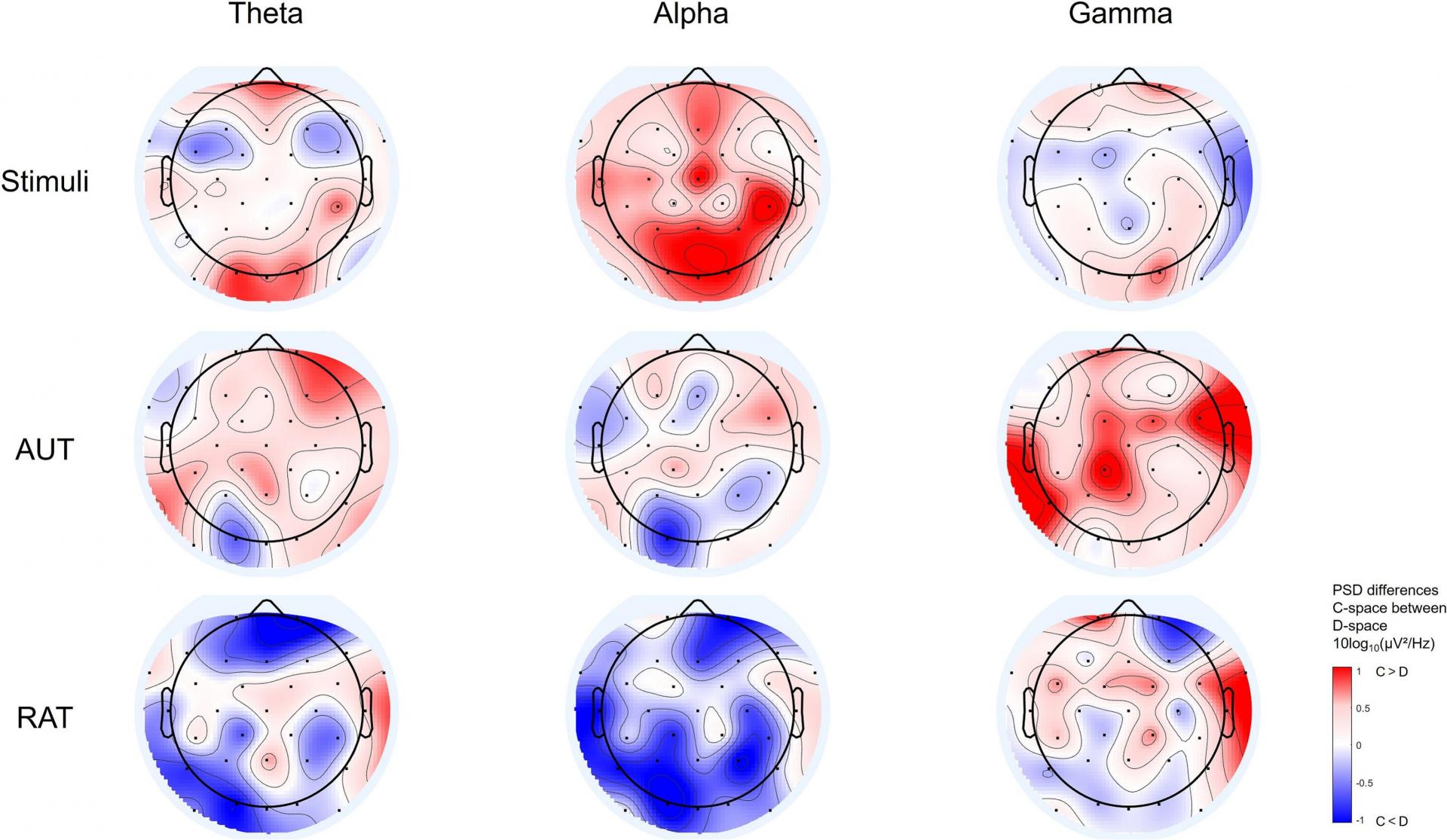
ABSTRACT This study examined how visual stimulation in virtual library environments affects creative thinking. Two virtual environments were designed: a C-space (supporting convergent thinking), featuring a simple layout with monochromatic tones and minimal materials, and a D-space (supporting divergent thinking), incorporating diverse finishes, irregular shapes, plants, and a high ceiling. Fifty-five Korean university students completed the Alternate Uses Task (AUT) and the Remote Associates Test (RAT) in both environments, while their brain activity was recorded via electroencephalography (EEG). Surveys measured psychological responses, including affective state and perceived restorativeness. Contrary to hypotheses, the visually simpler C-space facilitated both convergent and divergent thinking more effectively than the D-space. EEG results showed higher frontal theta, alpha, and gamma activity during AUT in the C-space, indicating greater cognitive engagement and internally oriented attention. During RAT, decreased parieto-occipital alpha power and increased gamma power suggested enhanced mental imagery for problem-solving. Although students perceived the D-space as emotionally positive, its visual complexity appeared to hinder sustained attention. These findings align with cognitive load theory, highlighting that reduced visual complexity supports creative cognition by minimizing distractions. While further validation in real-world settings is needed, this study offers preliminary insights for optimizing library design to enhance creativity.
|
| 
|

ABSTRACT
This study examined how visual stimulation in virtual library environments affects creative thinking. Two virtual environments were designed: a C-space (supporting convergent thinking), featuring a simple layout with monochromatic tones and minimal materials, and a D-space (supporting divergent thinking), incorporating diverse finishes, irregular shapes, plants, and a high ceiling. Fifty-five Korean university students completed the Alternate Uses Task (AUT) and the Remote Associates Test (RAT) in both environments, while their brain activity was recorded via electroencephalography (EEG). Surveys measured psychological responses, including affective state and perceived restorativeness. Contrary to hypotheses, the visually simpler C-space facilitated both convergent and divergent thinking more effectively than the D-space. EEG results showed higher frontal theta, alpha, and gamma activity during AUT in the C-space, indicating greater cognitive engagement and internally oriented attention. During RAT, decreased parieto-occipital alpha power and increased gamma power suggested enhanced mental imagery for problem-solving. Although students perceived the D-space as emotionally positive, its visual complexity appeared to hinder sustained attention. These findings align with cognitive load theory, highlighting that reduced visual complexity supports creative cognition by minimizing distractions. While further validation in real-world settings is needed, this study offers preliminary insights for optimizing library design to enhance creativity.
Journal Access